
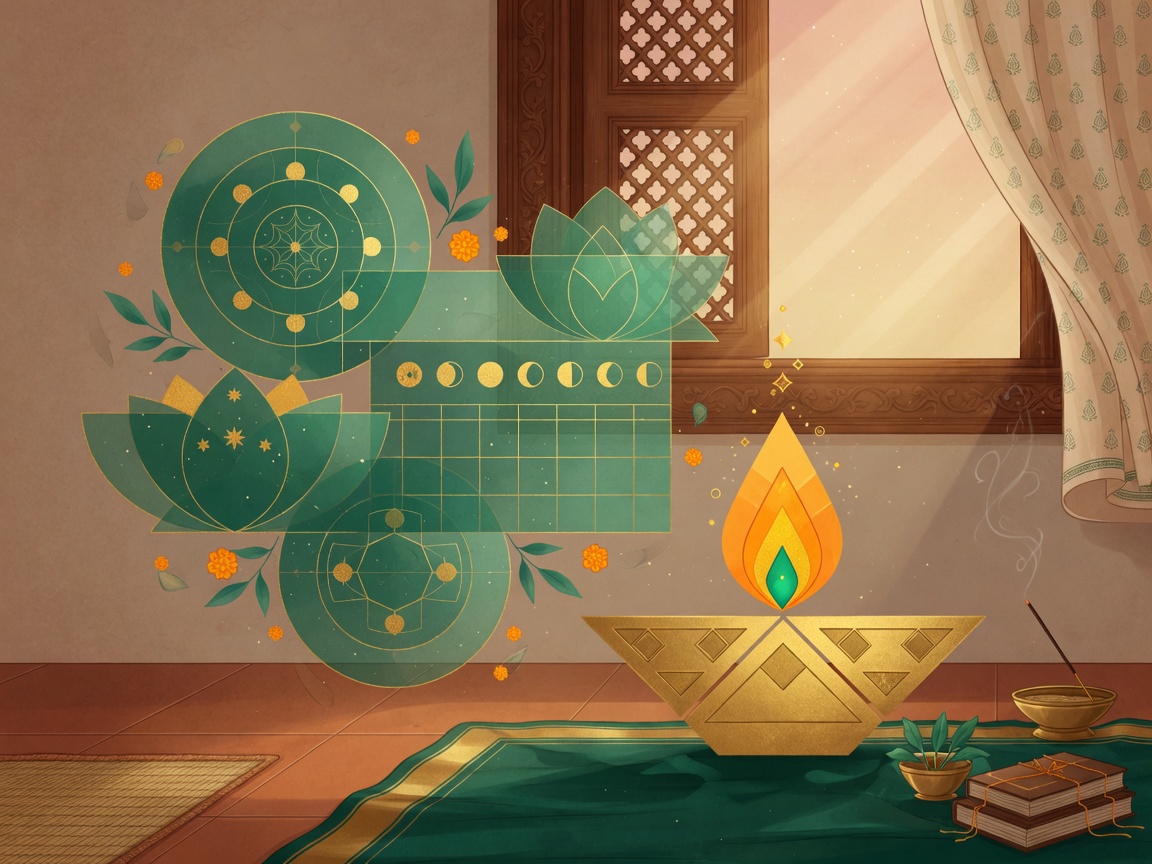
Why two calendars disagree about the same festival
Festival dates differ for two separate reasons: how the Moon's position is computed, and which part of the day the tithi must cover. Getting a date right means getting both.
Also in हिन्दी
Direct answer
Why do panchangas give different dates for the same festival?
Two layers differ. Some almanacs compute the Moon from traditional tables (vakya), others from computed positions (drik), and the two can disagree about when a tithi ends. Then each festival has an observance rule — the tithi must hold at sunrise, at midday, in the afternoon, at dusk or at midnight — evaluated for the local sunrise and sunset. The Astro Engine computes positions with the Swiss Ephemeris and evaluates each festival's rule for the latitude, longitude and timezone in the request.
Often, around Janmashtami, Diwali or an Ekadashi, two printed calendars in the same home disagree by a day. Families assume one of them is wrong. Usually both are applying a rule — just not the same one, or not for the same place.
Layer one: how the Moon is computed
A tithi is a twelve-degree step in the angle between the Moon and the Sun. Where it ends depends chiefly on where the Moon is computed to be, because the Moon moves about thirteen times faster than the Sun.
- Vakya almanacs use traditional tables — compact, memorable, and centuries old. Their Moon drifts from the observed Moon over time, and a small error in the Moon becomes a large error in time, because the Moon moves only about half a degree an hour.
- Drik almanacs compute the positions astronomically, aiming to match what is actually in the sky.
The two can place the end of a tithi at noticeably different times. When the boundary falls near sunrise, even a modest difference becomes a different day.
A small error in the Moon becomes a large error in time.
Layer two: which part of the day counts
Even with identical positions, a festival is not simply "the day of the tithi." The dharmashastra tradition ties each observance to a part of the day:
- Udaya tithi — the tithi in force at local sunrise, for most daytime observances.
- Madhyahna — midday, for observances such as Ganesh Chaturthi.
- Aparahna — the afternoon, for observances such as Vijayadashami.
- Pradosha — dusk, for Diwali and pradosha vratas.
- Nishita — midnight, for Janmashtami and Maha Shivaratri.
Sunrise and sunset are local. The same tithi, in the same sky, can cover the required window on one civil day in Kolkata and on another in Ahmedabad.
What the Astro Engine does
The engine's festival and panchanga calculations compute planetary positions with the Swiss Ephemeris, under the Lahiri ayanamsa, rather than from tables. Each named festival carries its observance rule, and the rule is evaluated against sunrise and sunset computed for the latitude, longitude and timezone in the request. Ask for the same festival in two cities and you may correctly get two dates — with the rule that produced each one.
Key takeaways
- Vakya tables and computed (drik) positions can disagree on when a tithi ends.
- Each festival names the part of the day its tithi must cover.
- Sunrise and sunset are local, so the same rule can give different dates in different cities.
- The engine computes positions, not tables, and evaluates the rule for the place asked about.
FAQ
Questions this essay answers
Is one almanac simply wrong?
Not necessarily. Many disagreements come from a different observance rule or a different city's sunrise, not from an error. Others come from the astronomical model itself — tables against computed positions.
What observance windows does the engine know?
Sunrise (udaya tithi), midday (madhyahna), afternoon (aparahna), dusk (pradosha) and midnight (nishita), plus moonrise for festivals that need it. Each festival is tied to its rule.
Does the location really change the date?
It can. A tithi that ends shortly after sunrise in one city may end shortly before sunrise in another, so the festival falls on different civil days.
On this site
Related pages
Continue reading
Related essays
Next step
The product is the proof.
Read more from the journal, or open Astro Ratan on WhatsApp and the web.